| | |
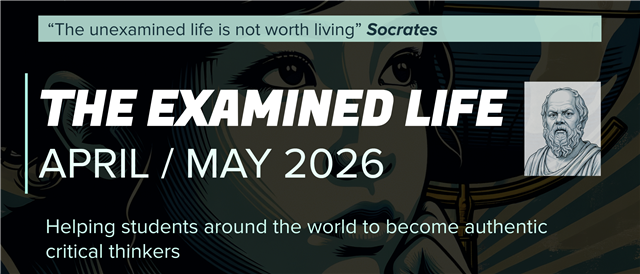
Welcome to our new-look newsletter! We've renamed it in homage to Socrates, rebooted the layout to make it more accessible than ever, and packed it with features to help ALL your students become nuanced, discerning knowers.
|
|
|---|
|
|
Welcome to
The
Examined Life, our new-look newsletter! |
|
|---|
|
|
We’re
very exited to reveal our new-look newsletter!
Drawing inspiration from Socrates’ famous quote, it offers a more accessible route into the stories we’ve selected over the last month, with better-designed questions, a homeroom debate for younger learners, and creative tasks enabling students to deep dive into issues and ideas that matter.
-
Taking Ownership identifies key terms and subjects links
-
Exploration poses critical questions and extended tasks to go deeper
-
The Homeroom Debate gives younger students access to the story
-
Leveraging the Story connects to university readiness and wellbeing
-
A beautiful new design help you to emphasise the significance and importance of the issues and ideas you’re examining.
We live in bewildering and fast-changing times, but theoryofknowledge.net, will help
all the members of your school to keep pace with the world.
|
|
|---|
|
A course-load of teaching and learning resources EVERY month! |
|
|---|
|
Use the mini-lessons to deliver your course (combined with our BQ or Classic quick starters), and provide your students with the most up-to-date TOK experience possible. Share the homeroom debates with the rest of your faculty to spread critical thinking throughout your school. Turn your younger students into Thinking Citizens (this month's batch of lessons coming very soon...).
If you'd like any guidance on embedding our resources in your curriculum, get in touch below. We can help you if you're either an existing member, and expired member, or a free user of the site.
|
|
|---|
|
Some of the highlights from this month's stories |
|
|---|
|
There is something for every classroom this month, and most stories touch on multiple disciplines, so we encourage all teachers to browse the full set. Here are some highlights to challenge, disrupt, and inspire your students.
|
|
|---|
|
|
The padlet gives you quick access to all the stories, arranged into different subject groups. This is the easiest way to share the resource with ALL your teachers. |
|
|---|
|
|
|
The homeroom debates present you and your learners with a short summary of each story, plus four debate questions, to get brilliant discussions going. |
|
|---|
|
|
|
|---|
|
| |
Follow the links below to take you to the 20 stories from the last month. Either go straight to the story and consider the key question, or hit the explore button and deliver the mini-lesson, knowledge journey, and homeroom debate.
If you're not yet a faculty member of the site you only have access a limited version of the newsletter (how sad!). JOIN US IN SECONDS HERE! |
|
|---|
|
1. TOUGHENED PINT GLASSES
Biology, Chemistry, Psychology, Health science
An FT story, exploring the essential role of trials in helping to produce reliable knowledge about science and other areas. Key question In a world overrun with unsubstantiated claims, is the ability to evaluate evidence now the single most important (scientific) skill we can develop?
|
|
|---|
|
2. RANKINGS AND DASHBOARDS
Digital society, Psychology, Individual cognition, Religion
A Conversation story, arguing that corporate algorithms are becoming our new moral authorities, and decide whether we are behaving appropriately or not. Key question Should algorithmic systems have a role in defining what constitutes moral and immoral behaviour for individuals and societies?
|
|
|---|
|
3. LOOK WHERE YOU'RE GOING
Visual arts, Politics
A Graffiti Street story, looking at the mysterious appearance of a statue on a famous street in London, which may or may not be a Banksy. Key question Art can challenge power in ways that reasoned argument cannot, but can it ever actually change it?
|
|
|---|
|
4. MAGIC OR STATISTICS
Mathematics, Psychology, Individual cognition
A Hannah Fry story, in which she ‘proves’ that a bankrupt British department store was built by ancient aliens, giving us an interesting insight into our brains. Key question If human beings are hardwired to find patterns and meaning in random data, can we ever fully trust our own interpretation of evidence?
|
|
|---|
|
5. JOURNEYS OF TASTE
Visual arts, History
A Guardian story, looking at the return to the Prado of the painting, The Year of Famine, which went from being the museum's most popular piece to an artistic joke. Key question The curator argues that taste, which each generation believes to be immutable, actually changes with every generation. If that is true, can any artistic judgement ever be more than a reflection of its moment?
|
|
|---|
|
6. DOCTOR OR MESSIAH?
Politics, Religion, Digital Society
A BBC story, looking at the recent image of Donald Trump portrayed as Jesus, and healing the sick, which was deleted after a negative backlash. Key question Does channelling religion enhance or undermine the knowledge communicated by a political leader?
|
|
|---|
|
7. SOCIETY OF THE MIND
Individual cognition, Psychology, Language, Sociology
A Big Think story, looking at you there is no such thing as ‘you’ - instead, your identity is a “society of the mind” which changes over time. Key question “It is a mistake to start looking around for the self in the brain.” What does Daniel Dennett mean, and what are the implications of this when we figure out who we are, and our place in the world?
|
|
|---|
|
8. 1000 YEARS OF THEORY
Religion, Politics, Law
A Guardian story, discussing the concept of the ‘just war’ in Christian theology, focusing on the current disagreement between the Papacy and the White House. Key question Do political agendas always distort our understanding of the world, or does it depend on the field involved?
|
|
|---|
|
9. PERMISSION TO HEAL
Biology, Health science, Psychology
A Conversation story, looking at how placebo treatments can work as well as ordinary treatments, but only as long as your body “gives them permission” to work. Key question If the body needs social permission before it will heal itself, does that mean human biology is shaped as much by power and authority as by facts and evidence?
|
|
|---|
|
10. PREDICTIONS ARE NEVER FACTS
Technology, Philosophy, Politics, Most subjects!
A TED story, featuring philosopher Carissa Véliz which she warns of trusting predictions, particularly ones generated by AI. Key question If predictions about human beings shape the very futures they claim to describe, can they ever be considered genuine knowledge rather than instruments of power?
|
|
|---|
|
11. HUMANITY VIA ZOOLOGY
Anthropology, Biology, The arts, Language
A BBC story remembering Desmond Morris, author of the influential
The Naked Ape, which applied a zoologist's perspective to studying human behaviour. Key question If every discipline produces a different account of what humans are, does that mean no single perspective can ever give us the complete truth about human nature?
|
|
|---|
|
12. SPEAKIN' PROPER ENGLISH
Language, History, Digital society
A Conversation story, arguing that “Despite all the likes, literallys and dropped g’s, English isn’t decaying before our eyes”. Key question If the rules of English have evolved continually over time, can we ever make truly objective judgements about correct usage?
|
|
|---|
|
13. TAKING CANDY FROM A BABY
Health science, Biology, Business, Digital society
A Guardian story, which offers a deep dive into the skincare industry for children, targeting young people down to the age of two or three years old. Key question When commercial interests override scientific evidence, can we ever trust that the knowledge driving our choices is genuinely in our interest?
|
|
|---|
|
14. HIDING BEHIND MATHEMATICS
Mathematics, Technology, Economics
A Forbes story, arguing mathematical models are not neutral instruments, but built out of intentional choices encoding specific value systems and worldviews. Key question If every mathematical model encodes the values of its designer, can any algorithmically produced decision ever be considered truly objective?
|
|
|---|
|
15. CLASSIC WORKS OF PROPAGANDA
Literature, Philosophy, Politics, Economics
A Big Think story, looking at how four famous novels were written as propaganda, to advance a specific worldview. Key question Does having an agenda undermine or strengthen a work of art?
|
|
|---|
|
16. FLATTERY AND SYCOPHANCY
Digital society, Computer science, Psychology, Individual cognition
An NPR story, investigating the extent to which AI chatbots ‘suck up’ to their users, and how this impacts the knowledge they provide us. Key question If the technology we use to access knowledge is designed to tell us what we want to hear, can we ever truly understand the world objectively?
|
|
|---|
|
17. EARTH RISING AND SETTING
Environmental science, Visual arts, Individual cognition
A BBC story, looking at what the images of the Earth taken by Artemis reveal about changes since the famous
Earthrise photo of 1968. Key question If a single photograph can achieve what decades of scientific data cannot, is emotional impact a more powerful driver of knowledge than evidence?
|
|
|---|
|
18. INTEREST OR OBSESSION
Psychology, Business, Visual arts
A Guardian story, focusing on a new serial killer exhibit in New York, and asking whether our obsession with true crime has gone too far. Key question When commercial interests shape how real events are presented to us, how do we distinguish between genuine knowledge and profitable spectacle?
|
|
|---|
|
19. TRUTH VERSUS AUDIENCE SIZE
Film, Music, Law
A Wired story, reporting on the ‘civil war’ that has kicked off as a result of the release of the biopic about Michael Jackson, pitting truth against accountability. Key question If each of us creates our own narrative about an artist, is a shared, collective truth about that person even possible? Does this apply to creators of knowledge in other areas of knowledge?
|
|
|---|
|
20. STRIVING FOR STATUS
Psychology, Education, but really for everyone!
A Conversation story, looking at the work of the Chinese philosopher Laozi, and what it can teach us when we are evaluating college and university rankings. Key question If our truest desires only emerge once we strip away society's expectations (as Laozi said), how much of what we believe we want is genuinely our own ambition?
|
|
|---|
|
Workshops & consultations |
|
|---|
|
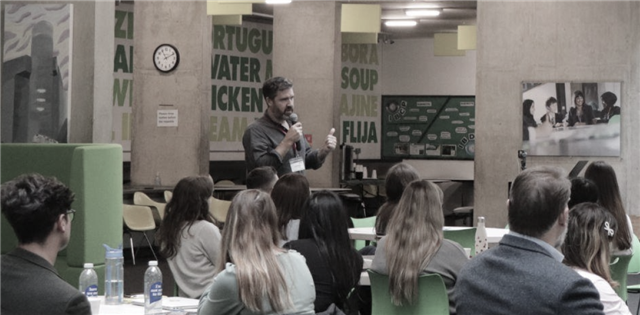
We're helping more and more schools around the world embed critical thinking into their curricula.
Whether you're looking to improve the way you deliver the TOK course, want to offer a similar course to your non-IB students, are trying to help younger students navigate the confusing and often hostile world safely, or are looking for a mechanism that helps produce an integrated learning experience, then we can help you.
We offer workshops for specialist and non-specialist critical thinking teachers, learning sessions for students, and consultations with school leaders about how to make your hub a genuine and effective critical thinking.
Find out more, and book a session here. |
|
|---|
|
http://theoryofknowledge.net/ |
|
|---|
|
| |
|
|
|